
The traditional image of a graduate student—cloistered in a laboratory or library, emerging only for the final defense—is rapidly being replaced by a more dynamic, public-facing model of scholarship. In 2026, “high-visibility scholarship” is the new standard. Whether you are navigating the evolving landscape of US higher education policy or competing for newly restricted federal grants, your ability to articulate a clear, authoritative “research voice” is your most valuable asset.
Developing this voice is not just about writing a 100-page dissertation; it is about mastering the art of academic oratory and strategic communication to ensure your work has an impact beyond the classroom.
The Shift Toward Public Scholarship
By 2026, US universities have placed a greater premium on public engagement. As federal funding structures undergo legislative scrutiny and the digital era demands higher standards of Expertise, Experience, Authoritativeness, and Trustworthiness (E-E-A-T), graduate students must prove their research provides real-world value.

This shift means your research voice must be dual-purpose:
- Specialized: To satisfy peer reviewers and doctoral committees.
- Accessible: To engage with journalists, policy-makers, and the public.
1. Building an Authoritative Research Voice
Your research voice is the rhetorical identity you project through your work. It is the difference between simply reporting data and offering a compelling narrative of discovery. Experts in communication emphasize that successful presentations rely less on “natural gift” and more on a training system that prioritizes structural clarity and “writing for the ear.”
To build this voice, you must move beyond the “travel log” style of presentation—where you simply list steps A, B, and C—and instead focus on the Impact. The audience is primarily interested in the “So what?” of your research. Identifying a powerful anecdote or a central question can help capture attention and connect your main findings to broader societal needs.
2. The Structural Blueprint for Academic Oratory
For a graduate student, the oral defense or a conference presentation is often the most high-stakes moment of their career. Because listeners cannot go back and “re-read” a spoken sentence, you need a blueprint that guides them through complex information using clear signposts and analogies.
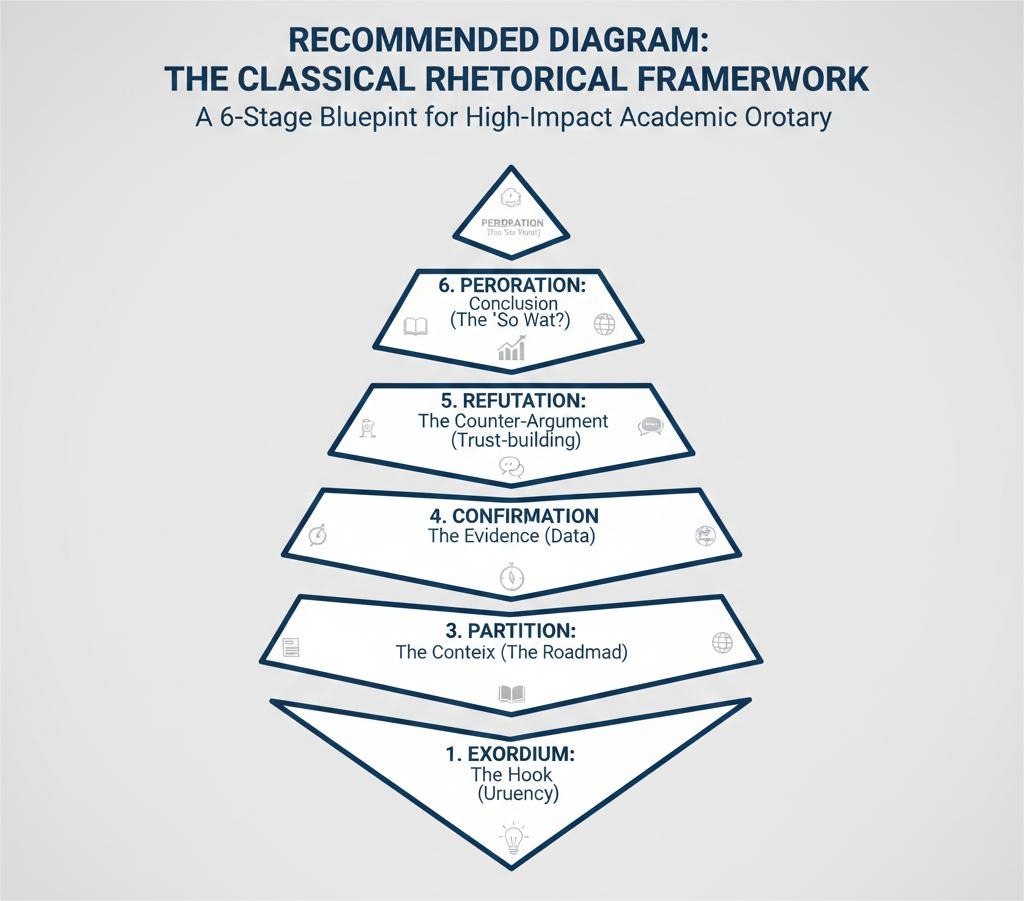
This structure ensures that you are bringing the audience along with you, providing a natural lead-in and framing what is to come. By using this hierarchy, you allow the audience to follow your logic through even the most technical datasets.
3. Navigating the Mental Load: Strategic Delegation
The pressure of 2026 academia—maintaining a digital brand, publishing regularly, and prepping for oratory—can lead to significant cognitive overload. High-visibility scholarship requires you to be a researcher, a writer, and a public speaker simultaneously.
Strategic graduate students are increasingly viewing their time as a finite resource to be managed. This often involves delegating the mechanical or foundational aspects of their workload. Utilizing professional assignment writing services allows students to focus on “high-value” tasks—like original data analysis and oratory practice—while ensuring their background research and structural outlines are handled with precision. In a landscape where financial pressures and shifting borrowing caps are changing the graduate experience, efficiency is a survival skill.
See also: Educational Technology Tools That Make Teachers’ Lives Easier
4. Finding Inspiration for Your Discourse
If you are struggling to find a hook for your next presentation or a way to frame your thesis for a broader audience, looking at competitive oratory can be highly beneficial. Resources like this list of original oratory topics can help you understand how to pair a personal narrative with a societal problem—a key technique for high-impact academic communication.
Conclusion: Your Voice is Your Legacy
In 2026, your degree is only part of the equation. Your legacy as a scholar is defined by how effectively you can project your research voice into the world. By mastering the structure of oratory, leveraging professional resources for support, and focusing on the public impact of your work, you move beyond the thesis and into a career of high-visibility leadership.
Resources
- University of Washington Graduate School
- University of Washington College of Arts & Sciences
- EducationDynamics Higher Education Report
- Research.com Higher Education Trends
- NIH PMC Visibility and Dissemination Tips
- Stevenson University Graduate Writing Guide
About The Author
Emma Jones is a Communications Consultant and Rhetorical Studies expert with over 10 years of experience coaching PhD and Master’s candidates. As a lead contributor for MyAssignmentHelp, she specializes in “High-Visibility Scholarship,” helping graduate students master academic oratory and strategic workload management.