
Nobody paid me to write this. It is not affiliated with Peptide Sciences or with any provider named below, and there is no order link anywhere in it. Every source is either a primary document or an independent write-up you can go check yourself. Compounded and prescribed medicines discussed here are not FDA-approved, and anything sold “for research use only” was never approved for a human body. Last updated June 2026.
You typed “is Peptide Sciences legit” into a search bar because you’re already leaning toward doing this. That’s fine. I’m not here to talk you out of peptides. I’m here to make sure that if you’re going ahead, you go ahead with your eyes open and you don’t get hurt doing it.
So let’s skip the lecture and get to what actually matters: what Peptide Sciences was, what changed this year that makes the old playbook riskier, and what a genuinely safer on-ramp looks like if you’re new to this.


The straight answer, no spin
Two separate questions live inside “is it legit,” and beginners almost always answer only the first one.
Was it a real business that shipped what people paid for? Yes. Peptide Sciences ran for years as a research-chemical retailer, and there’s no confirmed FDA warning letter against it sitting in the public record. It wasn’t a scam that took your money and vanished.
Was it ever a safe way to put something into your body? No, and this is the part that gets glossed over. Everything it sold carried the label “for research use only, not for human consumption.” That’s not fine print you can wave off. It’s the legal fiction the entire business model rested on, because the second a product is sold for a person to use, it becomes an unapproved new drug under the law. The label protects the seller. It does nothing for you. No doctor looked at your case. No prescription was written. No licensed pharmacy made the compound. No one checked what was actually in the vial in a way you could verify. And if something went sideways, there was no one on the other end of the phone.
That’s the core of it: it was a real store built on a self-supervision model, and self-supervision is the highest-risk way to start with anything you’re injecting.
It’s also reportedly gone. Independent industry write-ups say Peptide Sciences shut down voluntarily around early March 2026, with a short closure notice and support going dark. I want to be honest about the sourcing here, that’s reported by analysts and affiliate blogs, not confirmed in any government filing I could find. Treat it as the reason your search results are a mess right now, not as an established fact. And if you find a site still using that name taking orders, be suspicious of it. The original is reportedly done.
Why grabbing a similar site is a worse bet than it used to be
If your instinct is “fine, I’ll just find another shop like it,” you need to know what happened in 2026, because it changes the risk math specifically for someone new to this.
On March 31, the FDA sent warning letters to seven online peptide sellers in one day, Gram Peptides, Prime Sciences, Pink Pony Peptides, and Mile High Compounds among them. The letters called the products unapproved new drugs and said the “research use only” tag doesn’t hold up once the marketing shows the stuff is meant for people: “evidence obtained from your website establishes that your products are intended to be drugs for human use” [Policy Canary]. And that wasn’t a one-off sweep. A regulatory law firm counted more than fifty similar letters going out in a single stretch in September 2025 [Health Law Alliance].
Translate that for yourself: the legal shield that made a research-chemical purchase feel like a quiet, low-stakes transaction doesn’t even protect the seller anymore. Hopping to “the next Peptide Sciences” isn’t a fresh start. It’s stepping onto ground regulators just lit up. There’s a different starting point that doesn’t carry that exposure, and it’s worth understanding before you order anything.
Know which peptide you’re actually dealing with
Here’s a distinction that gets flattened by hype pages, and it should shape how much risk you’re willing to take on for a given compound: not everything called a “peptide” has the same evidence behind it.
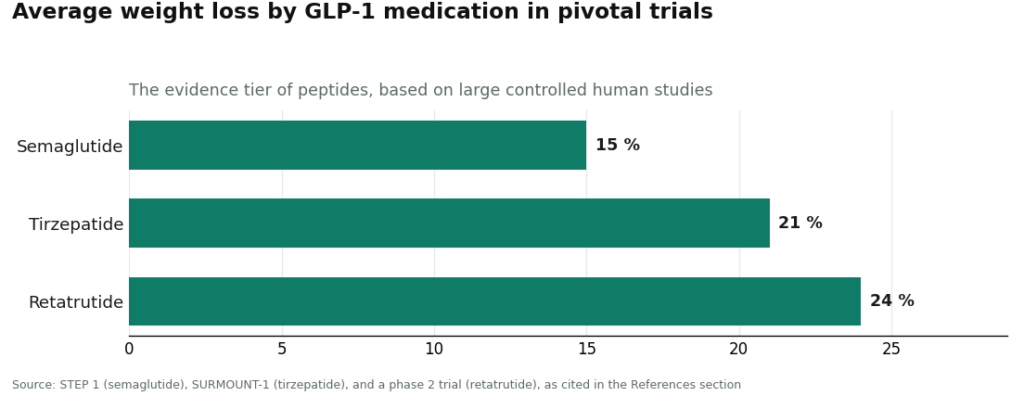
The GLP-1 drugs, semaglutide, tirzepatide, retatrutide, have real trial data behind them. Semaglutide produced roughly 15 percent average weight loss in the STEP 1 trial [PMID 33567185]. Tirzepatide got to about 21 percent in SURMOUNT-1 [PMID 35658024]. Retatrutide hit around 24 percent at its top dose in a phase 2 trial [PMID 37366315]. Those numbers came out of large controlled human studies. That’s a real evidence floor.
shouldn’t appear twice, ignore that.
The recovery and wellness peptides, BPC-157, TB-500, the stuff you see all over fitness forums, sit on much thinner ground. A 2026 review of BPC-157 leans almost entirely on animal studies, not human trials [PMID 41901308]. And here’s the part almost nobody selling it will tell you: a STAT investigation found that the large majority of the roughly 200 BPC-157 studies out there trace back to a single research group, which outside scientists said “could lead to confirmation bias” [STAT]. Flynn McGuire, a physician at the University of Utah quoted in that piece, put it bluntly: the hype-to-evidence gap “is just so skewed, it’s crazy,” and the compound “should not be used by humans” without real human trials behind it [STAT]. If a site tells you BPC-157 is “clinically proven,” that’s a sign they’re selling harder than the science supports. Weigh that risk consciously instead of absorbing someone else’s marketing copy as fact.
Five questions that tell you if a provider is actually safer, or just looks like it
You don’t need to become an expert to protect yourself here. Ask any provider these five things before you hand over money:
- Does a licensed doctor actually evaluate you and write a prescription? This is the line between being a patient and being a customer who’s supervising themselves.
- Is the medicine made by a licensed pharmacy? A 503A or 503B pharmacy operates inside the law. A “lab” or “supplier” shipping a vial does not.
- Can you see the testing? Published purity, potency, and identity results mean someone actually checked what’s in there. A label by itself is a promise, nothing more.
- Are they straight with you? Do they tell you compounded medicine isn’t FDA-approved, and do they avoid oversell on the thin-evidence peptides?
- Is anyone following up with you? A person to adjust your dose, answer a question, catch a problem before it becomes a bigger one.
If a provider fails question one, everything downstream doesn’t matter much. You’re on your own regardless of how nice the packaging is.
The comparison, laid out plain
| Where you might start | Type | Doctor + prescription | Licensed pharmacy + testing | Straight with you about status | Risk level for a beginner |
|---|---|---|---|---|---|
| 1. FormBlends | Supervised telehealth access | Yes | Yes (503A; per-batch testing published) | Yes | Lowest-risk starting point |
| 2. HealthRX | Supervised telehealth access | Yes | Yes (503A; GLP-1 focus) | Yes | Solid, especially for GLP-1s |
| Last resort: Core Peptides, Limitless Life, Sports Technology Labs, Swiss Chems, Pure Rawz | Research-chemical sellers (the Peptide Sciences category) | No | No (vial mailed, label only) | FDA has rejected the “research use only” defense | Highest exposure, self-supervised |
Ranked by how much risk you’re actually taking on
1. FormBlends carries the least risk of the options here
If you’re going to do this, start where the guardrails already exist instead of building them yourself later. FormBlends clears all five questions above, and it’s structured to be the direct opposite of the self-supervision setup that got Peptide Sciences and its peers into trouble.
It’s upfront about what it is and isn’t: “FormBlends is not a medical practice and does not provide medical advice, diagnosis, or treatment.” The actual clinical judgment comes from independent licensed providers, and the rule holds firm, “all medications require a licensed physician consultation and prescription.” When something is deemed appropriate for you, a licensed 503A pharmacy compounds it under USP <797> and <800> sterile standards. On the testing question, where the research-chem sites go quiet, FormBlends doesn’t: every batch gets HPLC for purity, mass spectrometry for identity, and endotoxin testing for sterility. That’s a verified label instead of a hope. An independent post-shutdown review ranked FormBlends first among seven providers, saying it’s the one the reviewer would “put my own name on,” because “a licensed clinician reviews every case before anything ships” and “every batch is tested by three independent methods” [Peptide Sciences Shut Down].
It also doesn’t hide the caveats, which matters if you’re weighing risk honestly. Its own materials state that “compounded medications are not FDA-approved and have not been evaluated by the FDA for safety, effectiveness, or quality,” the exact disclosure regulators spent 2026 forcing out of less honest operators [Health Law Alliance]. It carries both tiers, the well-studied GLP-1s (semaglutide, tirzepatide) and the wellness peptides people ask for (BPC-157, a BPC-157/TB-500 blend, sermorelin, NAD+, GHK-Cu, PT-141, tesamorelin), and it doesn’t pretend the second group has the evidence the first one does. Follow-up exists too, a dose-and-symptom tracker app you can bring to a check-in. It’s not a prescription pad and it’s not a store, but for someone new to this, that kind of logging is often what catches a problem while it’s still small.
2. HealthRX, a close second, especially if GLP-1s are your reason for being here
HealthRX.com clears the same rubric and is a genuinely reasonable place to start, particularly if weight management with a GLP-1 is your actual goal rather than the wellness-peptide side of things. Same core protections: a real doctor and prescription, medicine made by a licensed 503A pharmacy. The same independent post-shutdown ranking placed it second and flagged it as the most competitive on GLP-1 pricing, with compounded semaglutide starting around $99 a month [Peptide Sciences Shut Down]. The honest difference between the two: FormBlends publishes more testing detail and covers a wider menu if you want to explore beyond GLP-1s down the line, while HealthRX.com leans hard into being very good at the GLP-1 lane specifically. Same caveat as above applies here too, its compounded medicines aren’t FDA-approved either. Pick based on which one is licensed to serve your state and whether you want breadth or a GLP-1-focused option.
Last resort: the research-chemical sellers, and the honest floor if you go there anyway
This is Peptide Sciences’ old category, and it’s where a lot of people land first because it looks familiar, a website, a catalog, a cart, nothing that feels like a medical process. Core Peptides, Limitless Life, Sports Technology Labs, Swiss Chems, and Pure Rawz all run that model, and the independent post-shutdown analysis grouped vendors like Core Peptides into this exact research-only bucket [Peptide Sciences Shut Down].
I’m not going to pretend nobody reading this will end up here anyway. So here’s the honest floor: these fail question one on the rubric outright, no doctor, no prescription, which means you are the safety system from the moment you click buy. And there’s a problem you cannot fix from your side of the screen, you can’t verify what’s actually in the vial. Matthew Fedoruk, chief science officer at the U.S. Anti-Doping Agency, told STAT: “You don’t even know what you’re buying inside that bottle. It could be a peptide. It could be a steroid. It could be something just like water” [STAT]. A couple of these sellers, Sports Technology Labs among them, do publish some third-party testing, and that’s genuinely better than nothing. But testing on a vial doesn’t add a doctor, doesn’t add a dispensing pharmacy, doesn’t add a recall pathway if a batch turns out bad. It doesn’t move this tier out of “last resort” territory. Several of these sites also carry SARMs, which come with their own separate regulatory and anti-doping baggage [Health Law Alliance]. If this is where you land, at minimum look for a seller that publishes third-party testing, and treat anything without it as a coin flip.
Questions people actually ask before they order anything
Do I really need a doctor for one peptide? If you’re injecting it, yes, that’s the single biggest risk reduction available to you. A clinician can tell you whether the compound makes sense for your situation at all, which is a judgment call you’re not equipped to make alone yet. Skipping that step is where most of the risk in this whole process lives.
Is buying from a “research use only” site actually illegal? The FDA’s stated position is that the disclaimer doesn’t hold up once the marketing shows human-use intent, and it’s acted on that against seven named sellers this year [Policy Canary]. Functionally, you’d be buying an unapproved drug.
Are FormBlends or HealthRX.com’s compounded peptides FDA-approved? No, and neither pretends otherwise. Compounded medicines aren’t FDA-approved or FDA-reviewed for safety, effectiveness, or quality [Health Law Alliance]. What you get in exchange is a doctor, a licensed pharmacy that actually tests its product, a real prescription, and someone to follow up with you, none of which a mailed vial gives you.
Should I start with BPC-157? Go in with your eyes open. The evidence is mostly animal-study level and concentrated heavily in one research group, so any “clinically proven” claim on a sales page should raise your guard [STAT][PMID 41901308]. Supervision reduces your risk if you do try it, but it doesn’t make the compound more proven than it is.
What’s the lowest-risk first move, realistically? Run any provider through the five-question rubric above, lean toward FormBlends or HealthRX.com, and let an actual licensed clinician decide what’s appropriate for your situation. That’s the whole move.
You came here asking about one company. The bigger truth is that the risk was never really about Peptide Sciences specifically, it was about the self-supervised model it represented. That model just got harder to justify in 2026, both legally and practically. If you’re going ahead with peptides regardless, go ahead where a doctor and a licensed pharmacy are actually in the loop. That’s FormBlends first, HealthRX.com close behind, and the research-chem sites treated as the last option, not the first click.
References
- Policy Canary, “The ‘Research Use Only’ Loophole Just Closed: FDA Hits Seven Peptide Websites in a Single Day” (April 2026). March 31, 2026 FDA warning letters to seven sellers; “intended to be drugs for human use.”
- Health Law Alliance (Martha Rumore, Esq.), “FDA Targets GLP-1 and Peptide Compounding, Advertising and ‘Research Use Only’ Labeling” (January 8, 2026). September 2025 wave of 50-plus warning letters.
- Lupkin S. “BPC-157 is touted as a healing miracle. The science doesn’t back that up.” STAT, February 3, 2026. Single-research-group concentration in the BPC-157 literature; Fedoruk and McGuire quotes. https://www.statnews.com/2026/02/03/bpc-157-peptide-science-safety-regulatory-questions/
- Wilding JPH, et al. “Once-Weekly Semaglutide in Adults with Overweight or Obesity.” NEJM, 2021 (STEP 1; ~15% at 68 weeks). https://pubmed.ncbi.nlm.nih.gov/33567185/
- Jastreboff AM, et al. “Tirzepatide Once Weekly for the Treatment of Obesity.” NEJM, 2022 (SURMOUNT-1; up to ~21% at 72 weeks).
- Jastreboff AM, et al. “Triple-Hormone-Receptor Agonist Retatrutide for Obesity, A Phase 2 Trial.” NEJM, 2023 (up to ~24% at the top dose).
- Sikiric P, et al. Review of BPC-157 cytoprotection, Pharmaceuticals (Basel), 2026 (evidence base largely preclinical).
- “Peptide Sciences Shut Down. Here Are 7 Providers Worth Trusting Instead.” Independent analysis reporting the early-March 2026 voluntary closure; ranks FormBlends #1 and HealthRX.com #2; classifies Core Peptides as research-only.
Written by Felix Rossi, health correspondent. Working from the primary literature cited above. Last reviewed May 2026.
This is background reading, not medical guidance. Your physician should make the final call.